New Tanking System "Is"

The NBA has officially announced its new tanking/lottery system, and I can confirm that it exists.
Doing some research in March for Bleacher Report (The Best Way to Fix the NBA’s Tanking Crisis), I came to very different conclusions, apparently, than the league on what was needed. Elaborating further on the Substack (Punishing Teams for Being Lousy Keeps Them Lousy Longer), my primary concerns center on the natural life cycle of an NBA franchise from near-contending to restarting.
In short, almost every team will be terrible eventually. A three-year dip into the lottery is organic and rarely forced. The more egregious tanking has come from teams that pivot away from a playoff/play-in run around the trade deadline/All-Star break.
The NBA’s solution doesn’t address the problem I see. And that’s fine, as I’m not dogmatic enough to believe I alone have all the answers. Now, I’ve spoken to dozens of people across various teams who don’t understand what the NBA is doing here, perhaps addressing a perception more than a problem. But let’s put that aside and go into the new system with an open mind and see what happens.
The good news is this is only a three-year deal, leading up to the next Collective Bargaining Agreement negotiation. The NBA, together with the National Basketball Players Association, can come together to pursue broader change that the league can’t implement unilaterally. What changed officially on Thursday was outside the scope of the NBPA—shifts in internal NBA policy that were essentially collectively bargaining within the subset of 30 teams, not the players’ union.
Instead of a list of grievances, like the lack of grandfathering for teams like the Memphis Grizzlies and the first they got from the Utah Jazz for Jaren Jackson Jr., we’re going to look at the potential positives.
Here’s the NBA graphic on the new system:
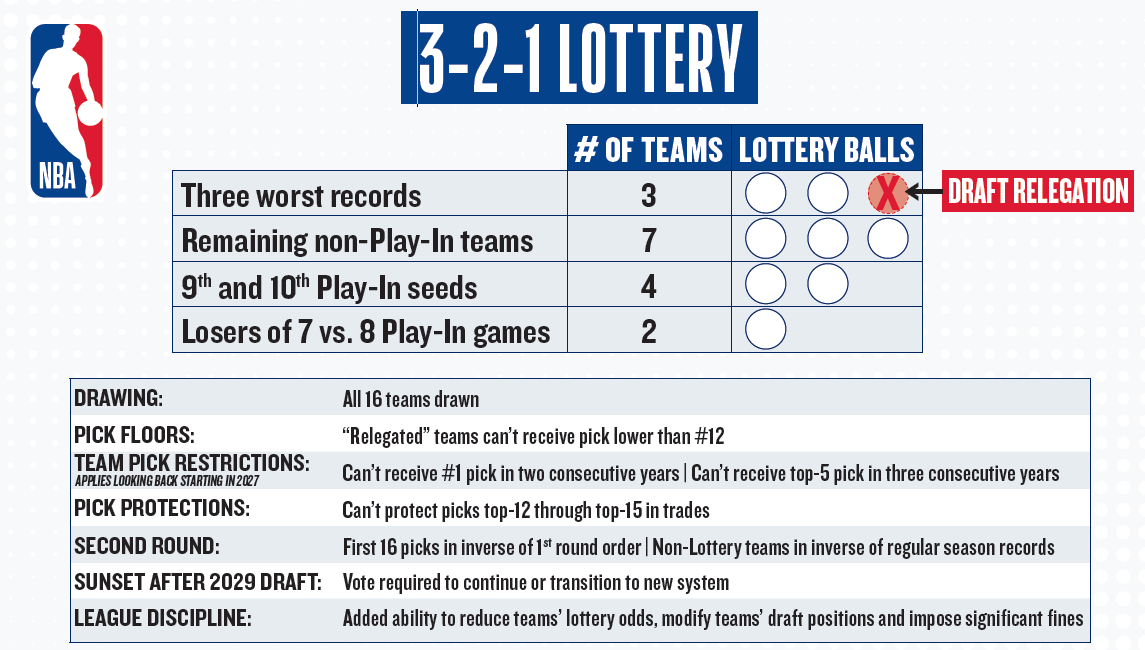
To translate, every pick will be selected now, not just the top-4. Instead of a backroom drawing with 1,000 combinations, it will be done live on the national broadcast with each team owning 3-2-1 lottery balls (thus the name “3-2-1 Lottery”). From an incentive point of view, missing the play-in, but not being a bottom-3 team, is the best spot to be in when chasing a notable prospect like Victor Wembanyama or Cooper Flagg. Also, if you’re going to make the play-in, better to go through two games to make it, for twice the odds.
Teams will game it, but they’ll need to do a better job of gaming/hiding it, because the league has greater discretionary power to punish those it deems guilty of tanking.
Counter to my approach, teams that are lousy for longer are barred from earning the No. 1 pick two years in a row. Also, no top-5 for three years, retroactively, which is what stings most for the Grizzlies re: the Utah pick.
Also, the second round is a jumble, with the lottery teams selecting in inverse order, as will the playoff teams in their section of the second.
Update: The rest of the second round would follow the normal order. The top overall record would draw at No. 30 and No. 60.
There’s a chance I’m reading the above incorrectly, or that the system’s implementation differs slightly from what is described.
The other item not addressed was the Jazz setting a “cliff” with top-8 in protection with the Oklahoma City Thunder. That is still allowed, but teams can no longer protect in the 12-15 range. We’ll see top-11 protections, but can’t do top-15 or even top-16.
So a top-20 protected first would have to include a gap, except if 12, 13, 14, or 15. What does that do for the Golden State Warriors’ selection heading to the Dallas Mavericks in 2030 with top-20 protection? Nothing, that’s outside the scope of the new system, which is three drafts through 2029.
Commissioner Adam Silver described himself as an “incrementalist,” but credit to him and the NBA, this isn’t incremental change. It’s a brand new concept that is going to take a lot to digest. It may be awful, terrible, sky-is-falling bad, but that’s more reactionary. I may not like the logic behind it, but I’m open to seeing the real-world implications.
At least it’s short-term.
The larger question I have is the impact on the trade market. It will have a significant one, but how exactly? That’s something I’ll explore in a future post.
I updated the list to 70 at Bleacher Report: Ranking the Top 70 Potential 2026 NBA Free Agents.
Some shifted based on playoff performance, NBA Combine intel, and subjective opinion. Any player can move +/- a few spots. It’s not a great free-agent market, and only the Brooklyn Nets, Chicago Bulls, and Los Angeles Lakers are projected to have significant cap room.
Still, there’s plenty of talent on that list that can help reshape several franchises for the better. Will that be enough to take down the New York Knicks, Oklahoma City Thunder, or San Antonio Spurs?
Regardless, looking forward to Game 7 on Saturday!